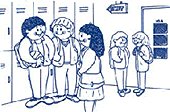
How I can help form good friendships and to resist harmful peer pressure?
Friendships can affect many areas of adolescent life-skills, how they spend their time, what clubs they belong and how they behave in public places like shopping malls. Youngsters who have difficulty forming friendships have a low self-esteem, do not stand out so well in school, sometimes not finishing high school, and fall into crime and suffer from a variety of psychological problems as adults .
Children of all ages need to feel they fit into your social life that are in their environment. Upon reaching adolescence, the need to be "part of the group is stronger than any other age. Friendships are closer and more important and will help determine who they are and where they go. It is more likely to form small groups or cliques, each with its special identity (eg, athletes, scholars, schoolchildren and the Stooges)
Many parents worry that their children's friends exert too much influence in their lives and that their influence will diminish. Parents worry even more if the friends of their children encourage them to participate in dangerous or harmful.
Studies by psychologist Thomas Berndt and colleagues have shown that friends do influence attitudes and behavior and that, over time, friends become more and more in their attitudes and behavior. For example, adolescents whose friends described themselves as problematic in school, tend to increase their own bad behavior in the course of the year.
The influence of friends feels much more from the seventh to ninth grades. During this time, friends often influence tastes in music, clothing and hairstyles, as well as activities in which to participate. However, peers do not replace parents. You remain who most influences the child's life. Adolescents tend to seek out parents more than friends when it comes to what plans do after high school, what career to choose and what religious and moral values \u200b\u200bwill follow. This influence is greatest when the relationship between father and son is strong.
Here are some tips to guide you in helping your child to form good friendships:
Teenagers tend to look to their parents than their friends when it comes to what plans do after high school.
- Recognize that peer pressure can be good or bad. Most adolescents are attracted to the friends who have many things in common. If your child chooses friends uninterested in school or take bad grades, may be less willing to study or do homework. If you choose friends who enjoy learning and get good grades, their motivation to excel academically will be stronger. Friends who avoid the use of alcohol or drugs will be a good influence on her son.
- Meet your child's friends. A good way to learn about your friends is to drive to events, talk to them in the car can reveal a lot. You can invite to your home. Help create a comfortable environment and offer something to eat. When friends come to visit you can allow your child to set the rules of conduct and at the same time give you the opportunity to better understand what they talk about and what are their concerns.
- Meet the parents of your child's friends. do not need to be intimate friends, but it helps to know whether the attitudes and preferences as parents are compatible with theirs. Former principal Carole Kennedy explains, "While the friend may seem okay, you need to know if an adult will be present in the other house to supervise." If you know the friends' parents will be easier to find what you need to know: where they go, with whom they are, what time activity begins and ends, will there be an adult and how they are transported to the event and home.
Spending time with friends, perhaps your child to change some behaviors that annoy others.
- Give your child free time in a safe place to hang out with friends. activities are important, but too many piano lessons and basketball practice can lead to burnout. Your child can develop new social skills and share ideas with friends if you allow free time to hang out with friends in a safe and supervised by adults. For example, among friends your child can learn that good friends know how to listen carefully, which are provided to help and are confident (but not too much), who demonstrate their enthusiasm, they have a good sense of humor and respect other people. Spending time with friends, perhaps your child to change some behaviors that annoy other people: being too serious or apathetic, too picky or stubborn.
- Talk to your child about friends, about friendship and how to make good choices. is very normal for teenagers to give much importance to what others think of them. Therefore it is extremely important that you talk to your kid about how to resist the pressure to disobey the rules or commit norms and values \u200b\u200bthat have been instilled. You can talk about being a good friend and how friendships are strengthened or diminished. You can also talk about the importance of making good decisions when riding with friends. "I always tell them, 'If it feels wrong, chances are it is,'" says teacher Barbara Braithwaite. Charles Summers The teacher tells his students and his own children, "You need to examine who you are when you're with that friend." He also suggests asking, "How do I want others describe me?" The answers that can guide children to give them to make better decisions.
- Teach how out of bad situations. Talk to your child about dangerous or inappropriate situations that may arise and how to cope. Ask your 14 year old daughter would do if a girlfriend came to an evening with a bottle of wine in her purse. Ask your 12 year old son what he would do if a friend suggested she leave school to buy hamburgers.
Ideally, young people can say "no" to a dangerous or destructive. But if you still have not learned this skill on their own, Ms. Marianne Cavanaugh, Connecticut mother suggested an alternative: "Sometimes kids do not want to do what the friends want to do. I tell my children blame me-to tell his friends that his mom says "no." Sometimes this takes away some pressure. "Finally, no child should leave home without change for the phone. As a last resort, this could save your life. A mobile phone may also be appropriate if family finances permit and if the boy knows how to use the phone responsibly.
- Monitor friendships to help your child avoid risky and unhealthy behaviors. Teens need supervision, especially during after school hours that are so important. Keep an eye on those who are friends your child and what they do when they get together. Bill Gangl, a middle school teacher in Minnesota, suggests, "Do not be afraid to be the annoying parent that calls the other house to make sure your child is there. And do not be afraid to say no."
Many middle school teachers and parents with children this age have different views on the consequences of trying to ban teens to get together with friends than their parents think they do not agree. Some youngsters will rebel if they are forbidden to hang out with some friends. Many adults who work with adolescents suggest better clarify the boy not only the fact that you do not feel comfortable with your choice of friends, but their reasons. They also suggest that you limit the amount of time and activities that let you do with those friends.
Many adults who work with adolescents suggest better clarify the boy not only the fact that you do not feel comfortable with your choice of friends, but their reasons.
- Set a good example as a friend. The example you provide has a greater impact than any sermon that can give you. Youngsters who see their parents treated with respect and kindness to each other and to their friends definitely have an advantage. Bake cookies for new neighbors or listening sympathetically when a friend may be sad a very powerful message for your child.


